
What Is llms.txt? The File, the Format, and Whether It Works
llms.txt promises a direct line to AI systems: 1 curated file that tells models what your site is and where the good pages are. Here is the format, a complete example, and the honest evidence on whether anyone is listening.
The short answer
llms.txt is a proposed standard: a plain-text markdown file at the root of a website that gives AI systems a curated summary of the site, with a title, a short description, and annotated links to its most useful pages. It was proposed in September 2024 by Jeremy Howard, co-founder of Answer.AI. Adoption is real, mostly on documentation and AI-company sites, but as of August 2026 no major AI engine has confirmed reading the file, so treat it as a cheap, harmless supplement rather than a visibility strategy.
llms.txt sits in a strange spot: widely recommended, widely published, and, as far as anyone can demonstrate, read by almost nothing. This guide covers the file from both ends. First the format, exactly, with a complete example you can copy. Then the evidence on whether publishing one changes anything, answered plainly, because the file takes 10 minutes and the claims around it are often bigger than that.
The file belongs to the wider practice of earning presence in AI answers, the discipline that travels under the GEO, AEO, and LLMO labels. If that vocabulary is new, our guide to what SEO for AI is called maps the acronym family; this article stays on the file itself.
Where did llms.txt come from?
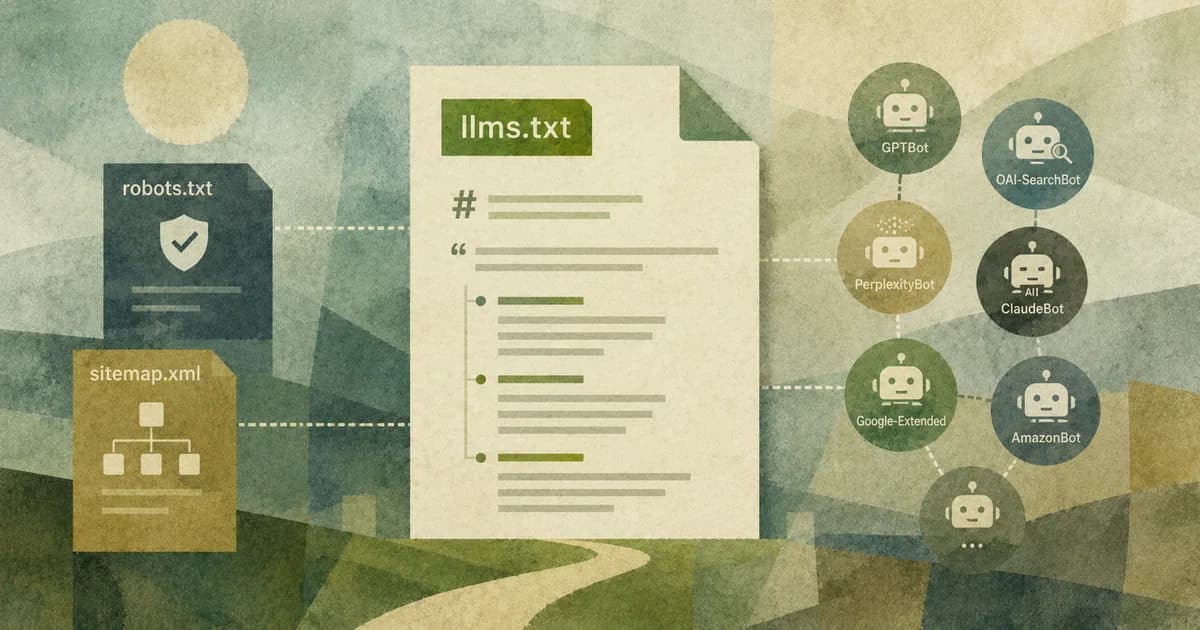
llms.txt is a proposal by Jeremy Howard, co-founder of Answer.AI, published on September 3, 2024 at llmstxt.org. The reasoning: language models work with limited context windows and read cluttered HTML poorly, so a website could offer them 1 curated markdown file at /llms.txt, with a title, a short summary, and annotated links to the pages that matter most. A menu written for machines, sitting beside the robots.txt and sitemap.xml files websites already publish for crawlers.
Adoption since then is real, but concentrated. Documentation sites picked the file up fastest: Anthropic publishes one for its developer docs, Perplexity and Cloudflare do the same for theirs, and Mintlify, a documentation host, generates the file by default for the sites it serves. Cruelx publishes its own at cruelx.com/llms.txt, and the directories tracking the format list hundreds of sites. What the list is short on is confirmation from the consuming side, and that is where this article is headed.
Does AI actually mention your business?
An llms.txt file cannot tell you whether AI engines recommend you. The Cruelx AI Visibility Scan measures it: 6 AI surfaces (ChatGPT, Gemini, Google AI Overviews, Google AI Mode, Perplexity, and Claude) are asked 15 buyer-style questions about your business, 3 times each, with every answer stored as evidence you can read.
The report shows per-engine appearance rates, a competitor benchmark, any misdescriptions the engines are spreading, and a prioritized fix list. $19.99, one time, no subscription.
What does the llms.txt format look like?
The format is deliberately small. It is a markdown file served as plain text at your domain root, and only 1 element is required. The table below is the complete anatomy; everything after the H1 is optional.
| Part | Required | What it does |
|---|---|---|
H1 title line, # Name | Required | Names the site or project. The only required element in the spec. |
Blockquote summary, > One short description | Optional, recommended | A plain-language summary of the site, directly under the title. The highest-value lines in the file. |
| Free-form details | Optional | Paragraphs or lists with context that does not fit in 1 sentence: who the site serves, how it is organized. |
H2 link sections, ## Pages | Optional | Group related links under headings such as Pages, Guides, or Docs. |
Link lines, - [Name](url): note | Optional | 1 line per URL: a markdown link plus a 1-line description after a colon, so a machine can pick the right page without fetching all of them. |
The ## Optional section | Optional | A section literally named Optional. The spec marks its links as safe to skip when a model is short on context. |
A complete llms.txt example
Here is the whole format in use, for a fictional dental clinic. This is a valid, complete file: nothing in the spec asks for more.
# Northgate Dental

> Northgate Dental is a family dental clinic in Portland, Oregon, offering preventive care, implants, and same-day emergency appointments.

Patients book online. Fees and accepted insurance plans are published on the pricing page.

## Pages

- [Services](https://www.northgatedental.com/services): Every treatment offered, with fees and recovery times
- [Pricing](https://www.northgatedental.com/pricing): Standard fees and accepted insurance plans
- [Book an appointment](https://www.northgatedental.com/book): Online booking, including same-day emergency slots

## Optional

- [Our team](https://www.northgatedental.com/team): Dentist bios and credentials
- [Blog](https://www.northgatedental.com/blog): Dental health guides and patient FAQs
- The H1 and the blockquote do most of the work. A model that reads nothing else still gets the business name, the category, and the location.
- Every link carries a 1-line description after the colon, so a system can choose the right page without fetching all of them.
- The Optional section holds the links a model can skip. The spec defines it as the part to drop when context runs short.
- The whole file is genuine markdown, which keeps it readable for any human who opens it too.
You can write the file by hand in any text editor, or use the free llms.txt generator and validator: it builds the file from your details and checks an existing file against the format, including the parts sites most often get wrong.
What is llms-full.txt?
The same proposal defines a companion file, llms-full.txt, which inlines the full text of your pages in 1 markdown document instead of linking to them. Documentation sites use it so a model can load an entire docs set in a single fetch; Anthropic’s runs to thousands of lines. For a typical business site it is overkill: the linked summary covers the use case, and a full-text mirror is 1 more thing to keep current. The spec also suggests offering markdown versions of individual pages by appending .md to their URLs; outside documentation tooling, almost nobody does.
Does llms.txt actually work?
Here is the honest answer: there is no evidence that llms.txt improves your visibility in AI answers, and no major engine has confirmed consuming the file. OpenAI, Google, and Anthropic all document their crawlers and their controls in detail, and none of that documentation mentions reading llms.txt. Google is the most explicit of the 3: its guidance on AI features in Search, updated in 2025, lists AI-specific text files among the things sites do not need for its AI features.
Google’s search relations team has been blunter still in public comments, comparing the file to the keywords meta tag: a place where sites describe themselves, which ranking systems learned long ago not to trust. Site owners who publish the file and watch their server logs report the same pattern from the outside: the major AI crawlers fetch pages, robots.txt, and sitemaps, and mostly leave /llms.txt alone. As of August 2026, publishing the file is a signal sent into a room where nobody has confirmed listening.
So why publish one at all? 3 modest reasons survive the evidence. User-directed AI agents (a model sent to your site by a person, a coding assistant, a research agent) can read the file when they arrive, and a curated summary gives them a better first page than your navigation. The cost is close to zero: 1 static text file, no code, no risk to anything that already works. And the exercise itself has value, because writing a 3-sentence summary of your business and choosing your 5 most useful pages is clarifying in the way good positioning work always is.
The work that measurably moves AI visibility lives elsewhere: crawlable rendered HTML, answer-first pages, third-party mentions, and the Google rankings AI engines retrieve from. Our guide to getting recommended by ChatGPT ranks those factors by evidence. And measurement beats faith in both directions: the Cruelx AI Visibility Scan asks 6 AI engines the questions your buyers ask and reports, engine by engine, whether you appear, for $19.99 one time.
How is llms.txt different from robots.txt and sitemap.xml?
llms.txt is often described as robots.txt for AI, and the comparison is exactly wrong: robots.txt controls access, while llms.txt controls nothing. The table separates the 3 files that live at the root of a site.
| File | Job | Status | Who reads it |
|---|---|---|---|
robots.txt | Tells crawlers which paths they may and may not fetch. | A convention since 1994, formalized as RFC 9309 in 2022. | Effectively every major crawler, AI crawlers included. |
sitemap.xml | Lists your URLs so crawlers can discover them all. | An established protocol supported by the major search engines. | Search engine crawlers, and the AI systems built on their indexes. |
llms.txt | Offers AI systems a curated markdown summary of the site. | A proposal from September 2024; not adopted as a standard. | No confirmed engine pipeline; AI agents and tools when directed to it. |
The practical consequence: if your question is which AI systems may access your site, the answer is in robots.txt. llms.txt cannot allow or block anything. It can only describe.
Which AI crawlers actually visit your site?
Because access lives in robots.txt, the decisions that matter are made per crawler, and the names are worth knowing, because each serves a different purpose. Blocking a training bot does not remove you from AI search, and blocking a search bot does not keep your content out of training. These are the robots.txt user-agent tokens behind the major AI surfaces.
| Crawler | Operator | What it is for | If you block it |
|---|---|---|---|
GPTBot | OpenAI | Collects public web content used to train OpenAI models. | Your content stays out of future training sets. ChatGPT search is unaffected; that is OAI-SearchBot. |
OAI-SearchBot | OpenAI | Crawls for ChatGPT search, the mode that cites and links sources. | ChatGPT search stops surfacing your pages as sources. |
ChatGPT-User | OpenAI | Fetches a page live when a user asks ChatGPT to read it. | ChatGPT cannot open your pages on request. |
PerplexityBot | Perplexity | Builds the index behind Perplexity answers. | Perplexity loses the ability to cite your pages. |
ClaudeBot | Anthropic | Collects public web content used to train Claude models. Claude-SearchBot and Claude-User handle search and user-directed fetches separately. | The same 3-way split as OpenAI: decide training, search, and live fetches per bot. |
Google-Extended | A robots.txt control governing whether your content is used for Gemini model training. Not a separate crawler. | Gemini training use stops. Google Search and AI Overviews are unaffected. |
Notice what the table does not contain: none of these crawlers documents llms.txt as part of its behavior, and all of them document robots.txt. Access is decided in 1 file, and it is not the new one. The free AI visibility checker reads your robots.txt and shows the verdict per crawler, and it checks whether your llms.txt is present and readable while it is there.
Should you create an llms.txt file?
Yes, on the smallest possible terms: because it is 10 minutes, free, and harmless, not because it will change your numbers. Here is the whole job.
- Write the summary. 1 H1 line with your business name, then a blockquote of 2–3 sentences saying what you do, who you serve, and where. This is the part a model is most likely to use if it reads the file at all.
- Choose the links. 5–15 pages that genuinely answer buyer questions: services, pricing, key guides, contact. 1 line of description per link. Skip the rest of your sitemap; curation is the point.
- Generate and validate. The free llms.txt generator produces the file in the correct format, and validates a file you already have against the spec.
- Serve it at the root. The file belongs at yourdomain.com/llms.txt as plain text. No redirect chains, no HTML wrapper.
- Then spend your energy up the stack. The measured levers for AI visibility are your content, your crawlability, and your third-party footprint. Our guide to making your website easier for AI to understand covers them in order.
That is the honest state of llms.txt in August 2026: a tidy idea, genuinely adopted on the publishing side, unconfirmed on the reading side, and cheap enough that none of that needs to stop you. Publish the file, spend the 10 minutes, and then put your attention where the evidence is.
Frequently asked questions
What is llms.txt?
llms.txt is a plain-text file, served at the root of a website at /llms.txt, that gives AI systems a curated markdown summary of the site: an H1 title, a short blockquote description, and sections of annotated links to the most useful pages. It was proposed in September 2024 by Jeremy Howard, co-founder of Answer.AI, as a way to hand language models clean context instead of cluttered HTML. It is a proposal, not an adopted standard.
Does llms.txt actually work?
There is no evidence that llms.txt improves AI visibility or search rankings as of August 2026. No major AI engine has confirmed using the file, and Google has said its AI features in Search require no special AI files. The realistic case for it is smaller: it costs a few minutes, it is harmless, and user-directed AI agents can read it when they visit your site. Treat it as a supplement, never a strategy.
What is the difference between llms.txt and robots.txt?
robots.txt controls access: it tells crawlers which paths they may fetch, and every major AI crawler documents a robots.txt token you can allow or block. llms.txt controls nothing: it is an optional curated summary a system may read if it chooses. If your question is which AI crawlers can reach your site, the answer lives in robots.txt, not llms.txt.
What is llms-full.txt?
llms-full.txt is a companion file from the same proposal that inlines the full text of your key pages in 1 markdown document instead of linking to them. Documentation sites use it so a model can load an entire docs set in a single fetch. For a typical business website it is rarely worth maintaining; the linked summary in llms.txt covers the use case.
Do ChatGPT, Claude, or Google read llms.txt?
None of them has confirmed reading llms.txt as part of answering or ranking, as of August 2026. Anthropic and other AI companies publish llms.txt files on their own documentation sites, which signals support for the idea, but publishing a file is not the same as consuming one. User-directed fetches are the exception: an AI agent sent to your site by a person can read the file like any other page.
How do I create an llms.txt file?
Write a markdown file with 1 H1 line naming your site, a short blockquote summary, and 1 or more sections of links with 1-line descriptions, then serve it at yourdomain.com/llms.txt as plain text. The free Cruelx llms.txt generator builds the file from your details and validates an existing file against the format. 10 minutes covers the whole job.
Does llms.txt help SEO?
No. llms.txt has no confirmed effect on search rankings, and Google's guidance on AI features in Search says no special AI files are needed. Time spent on AI visibility pays back further up the stack: crawlable pages, clear answer-first content, and the third-party mentions AI engines actually cite.
Related resources
See what your website is hiding.
Run a free Cruelx preview to get your score, top burns, and quick wins, then unlock the full multi-model report when you’re ready.