
GEO vs SEO: The Difference, and Why You Now Need Both
GEO vs SEO is the definitional question of 2026 marketing. Here is what each discipline optimizes, the 5 axes where they genuinely differ, what the acronym family means, and why the evidence says you need both.
The short answer
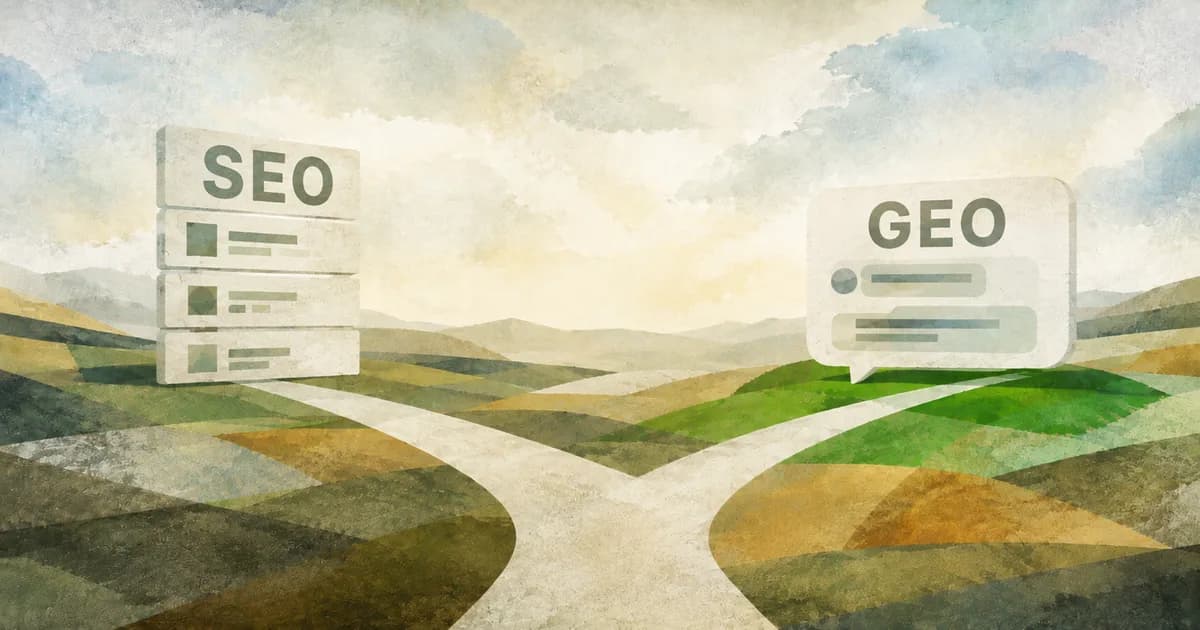
GEO vs SEO is a difference of destination. SEO (search engine optimization) earns your pages positions in ranked search results. GEO (generative engine optimization) earns your brand mentions and citations inside AI-generated answers from ChatGPT, Gemini, Perplexity, and Google’s AI surfaces. The 2 disciplines are complementary, not rivals: they share one foundation of clear, crawlable, well-evidenced pages, and a strong Google position measurably raises your odds of being cited by AI. What actually separates them is where results appear, which signals carry the most weight, and how success is measured.
Most GEO vs SEO comparisons stop at the definitions. This one goes further: the 5 axes where the disciplines genuinely differ, what the acronym family (GEO, AEO, AIO) actually means, the evidence that SEO feeds GEO rather than competing with it, and how GEO is measured in practice. If you want hands-on guidance for a small business site rather than the discipline comparison, our guide to SEO vs AI search optimization covers the practical checklist.
What do SEO and GEO actually mean?
Search engine optimization (SEO) is the work of earning visibility in ranked search results: making pages crawlable, relevant, trustworthy, and useful enough that engines like Google place them high on the results page when someone searches for what you offer. The unit of success is a position. Your page ranks 1st, 4th, or 40th, and clicks follow the position.
Generative engine optimization (GEO) is the work of earning presence in generated answers: shaping your website and your wider footprint, including reviews, comparison articles, and community threads, so that AI answer engines mention your brand, describe it accurately, and cite your pages when people ask buying questions in your category. The unit of success is an appearance. When 100 people ask ChatGPT for the best option in your market, GEO determines how often you are in the answer. Some marketers call the same practice answer engine optimization (AEO); the names differ, the work is nearly identical.
The definitions already hint at the relationship. SEO is about one surface with a stable format: the ranked results page. GEO is about many surfaces with a volatile format: answers that are composed fresh, sentence by sentence, from whatever sources each engine retrieves and trusts at that moment.
What is the difference between GEO and SEO?
5 axes separate the disciplines in practice. The table gives the short version; the sections after it explain each axis.
| SEO | GEO | |
|---|---|---|
| What you optimize | A page’s position in a ranked list of results. | Your brand’s presence inside a generated answer. |
| Where results appear | Search result pages on Google and Bing. | Answers from ChatGPT, Gemini, Perplexity, Claude, and Google’s AI Overviews and AI Mode. |
| Core signals | Relevance, links, authority, page experience, crawlability. | Extractable answers, citable evidence, third-party list placements, community presence, entity clarity. |
| How success is measured | Rankings, impressions, clicks, organic traffic. | Appearance rates per engine, mentions and citations, share of voice against competitors. |
| How fast results shift | Weeks to months; positions are comparatively stable. | Days to weeks; AI Mode replaces 56% of its cited sources week over week. |
What are you optimizing for?
SEO optimizes a page’s position in a list; GEO optimizes a brand’s presence in an answer. The distinction matters because a results page has 10 slots and losing one still leaves 9, while a generated answer has no fixed slots at all: you are either part of it or you do not exist in that interaction. GEO also reaches beyond your own website. AI engines assemble answers from reviews, comparison articles, and forum threads, so pages you do not own can carry, or cost you, visibility.
Where do results appear?
SEO results appear on search result pages; GEO results appear inside the answers themselves. That changes what a “win” delivers. A ranking win earns a click to your site. An answer win often is the whole interaction: the buyer asks, the engine names 3 options, and a shortlist forms without a single website visit. Being absent from that answer does not mean a lower position. It means no position. On Google’s results page, that answer surface is AI Overviews; our guide to ranking in AI Overviews covers earning a citation there.
Which signals carry the most weight?
SEO rewards authority and relevance; GEO rewards extractability and evidence. The measured GEO factors are specific. A 2024 study from Princeton and Georgia Tech researchers, presented at KDD, found that adding statistics, quotations, and source citations to a page lifts its generative visibility by roughly 30–40%. An analysis of ChatGPT’s citing behavior found 43.8% of cited pages are list-format “best X” roundups, and 35% of them come from low-authority domains, which means the entry bar sits far lower than classic link building. And Reddit is the single most-cited domain in AI answers, so community presence counts in a way traditional SEO never priced in.
How is success measured?
SEO success is measured in rankings and clicks; GEO success is measured in appearance rates: the share of relevant asks where your brand shows up in the answer. There is no fixed position to track, because the same question produces different answers run to run. Measurement therefore looks statistical rather than positional, which is a big enough difference to earn its own section below.
How fast do results shift?
SEO positions typically move over weeks and months; AI answers reshuffle in days. Google AI Mode replaces 56% of its cited sources week over week, so the sources behind an answer today are mostly different a month later. The practical consequence: GEO readings expire. A measurement from last quarter describes a set of answers that no longer exists.
Measure your GEO before you optimize it
The Cruelx AI Visibility Scan puts a number on your GEO: it collects 270 answers from the 6 AI surfaces buyers actually use, Claude and both of Google’s AI surfaces included, and stores every one as evidence you can read.
The report shows, engine by engine, where you are recommended, mentioned, invisible, or misdescribed, and ends with a fix list ranked by evidence. $19.99, one scan, no subscription.
GEO vs AEO vs AIO: what do all these acronyms mean?
Searches for SEO vs GEO vs AEO vs AIO all land on the same question. GEO, AEO, LLM SEO, and AI SEO describe near-identical practice: earning presence in AI-generated answers. The acronyms differ by era and emphasis, not by method, and no certification body referees which one is correct. Here is the honest map; the naming question itself, including where each label came from, has its own guide to what SEO for AI is called.
| Term | Stands for | What it means in practice |
|---|---|---|
| GEO | Generative engine optimization | The current umbrella term: optimizing to be mentioned and cited in AI-generated answers. |
| AEO | Answer engine optimization | An earlier name for the same practice, coined when featured snippets and voice assistants were the main answer surfaces. |
| AIO | AI optimization | Used 2 ways: as yet another umbrella term, and as shorthand for Google’s AI Overviews. Read it in context. |
| LLM SEO / AI SEO | Informal labels | The familiar SEO name bolted onto the new surface. Same work, different sticker. |
| AI visibility | Not an acronym | The outcome every term above chases: whether AI engines actually surface your brand. It is what you measure. |
One distinction from that table is worth keeping: GEO is the practice, AI visibility is the result. You do GEO; you have, or lack, AI visibility. The measurement side, including the metrics that make it up, has its own breakdown in our guide to what LLM visibility means.
Do you still need SEO if AI answers are taking over?
Yes: SEO is not merely still necessary, it is one of the strongest known inputs to GEO. Pages that hold Google position 1 are cited by AI engines in roughly 43% of relevant answers; pages at position 7 drop to roughly 5%. Generative engines retrieve much of their raw material from the same indexes that power search, so the ranking you earned for a query is also your ticket into the answers built on that query. Abandoning SEO would starve the retrieval pipeline that GEO depends on.
Google says as much itself. Its guidance on AI features in Search frames the work as fundamentally SEO: helpful, people-first content, with no separate trick list for AI surfaces. The honest reading of the evidence is not “SEO or GEO” but one body of work with 2 payoffs.
What does change is the payoff structure. A ranking used to buy clicks; it now buys clicks plus a seat at the table when answers are generated. That makes the foundation work more valuable, not less, and it makes the sites that quit SEO early doubly invisible: gone from the results page and gone from the answers built on it.
How do you measure GEO?
GEO is measured by asking AI engines the questions buyers actually ask, repeatedly, and recording the share of answers that mention, recommend, or cite you. Repetition is not optional. A single AI answer is statistical noise: the same question, asked again, routinely returns a different set of brands. Serious measurement samples each question several times and reports appearance rates, never single-run claims.
Per-engine reporting matters just as much. A 2,961-run study by SparkToro and Gumshoe in 2025 found that AI engines disagree with each other 54.5% of the time, so one blended score hides more than it shows. You can be strong on Perplexity and absent from Gemini, and the fix for each is different. The same research family quantified another trap: 61.7% of AI citations are ghost citations, where a domain is cited as a source while the brand is never named in the answer. Mentions and citations are 2 separate metrics, and a tool that conflates them will flatter you.
Done with enough samples, the method is stable. Cruelx scan data from 2026 puts the noise floor low: across repeated runs, 9 in 10 engine-question pairs hold their verdict, and whole-site repeat scans land within 2–9 percentage points of each other. The remaining piece is competitor benchmarking: the same questions that measure you also reveal which rivals the engines name instead, which turns a score into a target list.
The Cruelx AI Visibility Scan runs this exact method as a one-time product, sampling every question on every engine enough times to report rates instead of luck. The report gives per-engine appearance rates, separates mentions from citations, benchmarks competitors, flags misdescriptions, and ranks fixes by evidence. It costs $19.99 as a single scan, with a 3-pack at $49 and a 10-pack at $129, and there is no subscription. It is a point-in-time reading, not a monitoring dashboard: teams that want daily tracking are better served by a subscription tool.
Where should you start?
Start by measuring, because in most markets the race is still open: a 50,000-brand Semrush study found that 85% of product categories have no dominant AI-answer owner. The sequence that follows from everything above is short.
- Measure first. Get a per-engine baseline of where you stand today: which engines mention you, which recommend competitors instead, and which describe your business incorrectly. Without the baseline, every GEO effort is guesswork.
- Fix the evidence-ranked factors. Earn placements in list-format comparison pages, add statistics, quotations, and citations to your key pages, keep building the Google rankings that feed AI retrieval, and show up where your buyers ask questions, including Reddit.
- Re-measure after changes land. AI answers reshuffle weekly, so a reading decays. Scan again after each meaningful change and compare appearance rates against the baseline, not anecdotes against memory.
The improvement playbook in full, from building a source-of-truth website to earning third-party proof, lives in our guide to how to get recommended by ChatGPT and the other AI assistants. The order of operations stays the same either way: measure, fix, re-measure. SEO taught that discipline for 20 years. GEO just runs it on a faster clock.
Frequently asked questions
Is GEO replacing SEO?
GEO is not replacing SEO; it is growing alongside it, and the 2 disciplines feed each other. AI engines lean heavily on search indexes when they build answers: pages at Google position 1 are cited in roughly 43% of relevant AI answers, against roughly 5% at position 7. Dropping SEO would starve the very rankings that GEO draws on. The practical posture in 2026 is one foundation with 2 measurement systems.
What is GEO in digital marketing?
GEO (generative engine optimization) is the practice of increasing how often AI answer engines like ChatGPT, Gemini, and Perplexity mention, cite, or recommend your business when people ask questions in your category. It covers your own website, through clear, extractable, well-evidenced pages, and your wider footprint, like reviews, comparison listicles, and community threads. Success is measured as an appearance rate: the share of relevant AI answers that include you.
What is the difference between GEO and AEO?
GEO and AEO describe near-identical practice, and the terms are widely used as synonyms. AEO (answer engine optimization) is the older name, coined when featured snippets and voice assistants were the main answer surfaces. GEO (generative engine optimization) is the current term, centered on answers generated by large language models. When a tool or agency offers either one, look at what it actually measures rather than the acronym.
Do GEO and SEO use the same techniques?
GEO and SEO share most of their foundation: crawlable pages, clear structure, direct answers, and genuine evidence help both. GEO then adds emphasis of its own, like earning placements in third-party list articles (43.8% of ChatGPT-cited pages are list-format), adding statistics and quotable material to key pages, and building presence in communities like Reddit, the most-cited domain in AI answers. SEO-only habits like chasing exact-match keywords matter less in GEO.
How do you measure GEO success?
GEO success is measured as an appearance rate: ask AI engines real buyer questions many times and record the share of answers that mention, recommend, or cite you, engine by engine. Per-engine reporting matters because engines disagree with each other 54.5% of the time, and mentions should be tracked separately from citations. The Cruelx AI Visibility Scan runs this method across 6 AI surfaces with 270 collected answers per scan, for $19.99 with no subscription.
How fast do GEO results change?
GEO results shift on a scale of days to weeks, much faster than typical ranking movements. Google AI Mode replaces 56% of its cited sources week over week, so an answer that includes you today can drop you next week. That speed is why GEO measurement is built on repeated sampling and periodic re-scans rather than a single reading.
Is SEO dead in 2026?
SEO is not dead in 2026; it has become the supply chain for AI answers. Generative engines retrieve much of their material from the same pages that rank in search, which is why high Google positions correlate strongly with AI citations. What has changed is the payoff structure: a ranking now buys both clicks and a seat in generated answers. A site that abandoned SEO would lose both at once.
Related resources
See what your website is hiding.
Run a free Cruelx preview to get your score, top burns, and quick wins, then unlock the full multi-model report when you’re ready.