What Is Super Intelligence? SI vs AI, and Why Trump Renamed AI
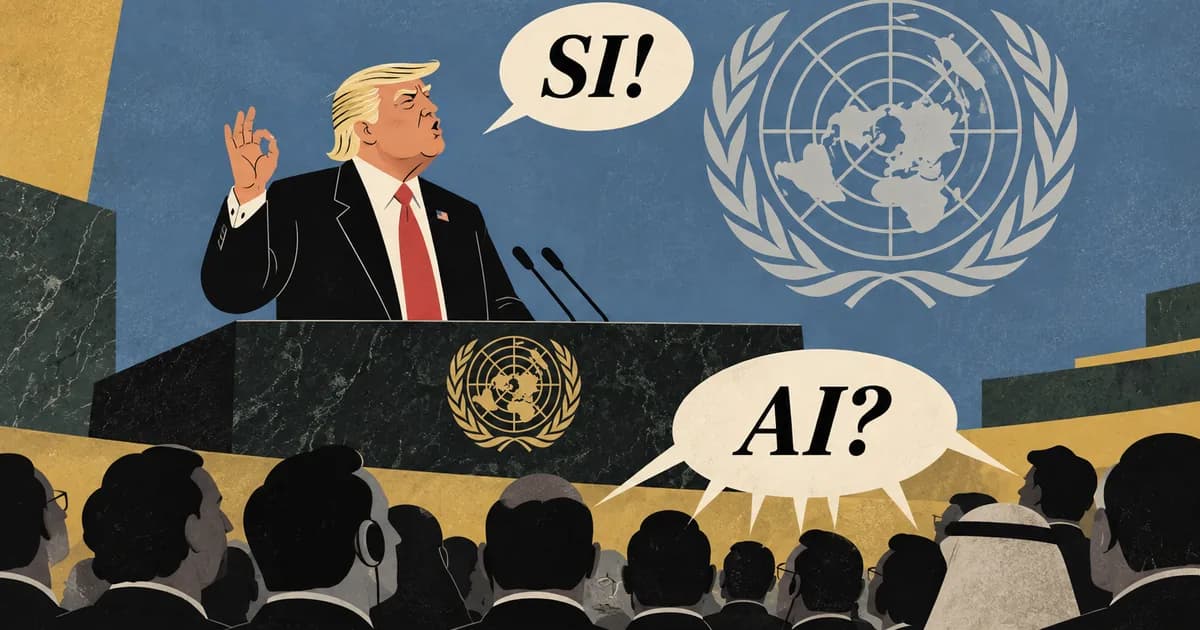
On September 22, 2026, President Trump told the UN General Assembly that US government documents will call AI “super intelligence” from now on. Here is what the term has meant for 200 years, how it differs from the AI you use today, the full timeline of the rename, and what it changes for a business.
The short answer
Super intelligence, usually written as 1 word, superintelligence, is a hypothetical AI that outperforms the best human minds at practically every cognitive task. Nothing like it exists today. On September 22, 2026, President Trump told the UN General Assembly that United States government documents will use the term super intelligence instead of artificial intelligence from now on. The rename changes the label, not the technology: ChatGPT, Gemini and Claude remain narrow AI systems, and the industry’s own definition of superintelligence describes a future stage no company has reached.
The word arrived at the UN with 2 centuries of history and a precise meaning in AI research, which is why the speech confused as many people as it impressed. This page settles it: what superintelligence means, how it differs from the AI on your phone, the day-by-day timeline of how AI became SI, whether the name will stick, and what, if anything, a business should do about it. If you came for the parallel naming argument in marketing, GEO versus AEO versus AI SEO, that lives in our guide to what SEO for AI is called.
What is super intelligence?
Superintelligence is the top rung of a 3-step ladder that AI researchers have used for decades. Narrow AI does 1 kind of task well. General AI, or AGI, would match a capable adult across most intellectual work. Superintelligence, often abbreviated ASI, would leave every human expert behind in nearly every field at once.
Strong inside 1 task or domain: translation, image recognition, chat, code. Every product on the market today, ChatGPT and Gemini included.
Matches a capable human across most intellectual work and carries what it learns between fields. Claimed as close by several labs, reached by none.
Exceeds the best human minds in practically every domain, and can improve its own design. Hypothetical. The word Trump chose for all of AI.
The standard definition comes from the philosopher Nick Bostrom, whose 2014 book Superintelligence: Paths, Dangers, Strategies defines it as “any intellect that greatly exceeds the cognitive performance of humans in virtually all domains of interest.” 2 words in that sentence carry the weight: greatly and all. A system that beats grandmasters at chess is narrow AI. A system that beats every grandmaster, every surgeon, every lawyer and every engineer, and then redesigns itself to do it faster, is the thing the word was coined for.
The word is older than the technology. Merriam-Webster dates the first known use of superintelligence to around 1822 and defines it as “an entity that surpasses humans in overall intelligence or in some particular measure of intelligence.” The dictionary updated the entry on September 16, 2026, 6 days before the UN speech, with example sentences about a congressional bill to ban the thing. That is the state of the vocabulary this week: 1 word, 200 years old, claimed by a president as a synonym for AI and by lawmakers as a technology to prohibit.
| Term | What it means | Exists today? | Where you meet it |
|---|---|---|---|
| AI (artificial intelligence) | The whole field: software that performs tasks that normally need human intelligence. | Yes | Every product label, every law, every search box. 301,000 US Google searches a month. |
| AGI (artificial general intelligence) | Human-level ability across most intellectual work, with learning that transfers between tasks. | No | Lab mission statements and investor decks. OpenAI’s charter is written around it. |
| ASI (artificial superintelligence) | Beyond the best humans in nearly every domain. Bostrom’s definition. | No | Research papers, Meta Superintelligence Labs, Safe Superintelligence Inc., and the 2025 statement calling for a ban. |
| SI (super intelligence, Trump’s usage) | A new name for all of AI, announced for US government documents on September 22, 2026. | As a label, yes. As a capability, no. | Federal wording from here on. Not adopted by the companies, the courts, or the dictionary. |
SI vs AI: what is the difference?
AI is the category. Superintelligence is a capability level inside it that has not been reached. So under the technical meaning, SI versus AI is not a contest between 2 technologies; it is the difference between a family and its most powerful hypothetical member. Every assistant you can open today, ChatGPT, Gemini, Claude, Copilot, is narrow AI with a wide vocabulary: impressive within a conversation, unable to set its own goals, and still dependent on a human to judge whether the answer is right.
The rename collapses that distinction. When a government document says super intelligence, it will mean the spam filter, the chatbot, the fraud model and the hypothetical future system in the same breath. That is the cost the research community objects to: the field loses its word for the one thing it worries about most. It is also why you will keep seeing both usages side by side, and why this page keeps them apart.
A practical test cuts through the confusion. Ask whether the system can take a goal it was never trained on, learn what it needs, and outperform the best human at it. If the answer is no, you are looking at AI, whatever the document calls it. If the answer were ever yes across the board, you would not need an announcement to notice.
Whatever it is called, it already decides who gets recommended
The systems in the headlines are the same ones your buyers ask for recommendations. The Cruelx AI Visibility Scan asks 6 AI surfaces (ChatGPT, Gemini, Google AI Overviews, Google AI Mode, Perplexity, and Claude) 15 buyer-style questions about your business, 3 times each (270 asks), with every collected answer stored as evidence you can read.
The report shows, engine by engine, where you are recommended, mentioned, invisible, or misdescribed, and ends with a prioritized fix list. $19.99, one time, no subscription.
What Trump said at the UN, and how AI became SI
The rename was not a single line in a speech. It was a 10-day arc that began as a dismissal of AI safety warnings and ended at the General Assembly podium, with a poll in between.
| Date | What happened | Source |
|---|---|---|
| Sept 11, Fri | More than a dozen OpenAI and Anthropic insiders call for a slowdown. Trump dismisses AI extinction risks. | CNBC |
| Sept 13, Sun | Trump declares that whoever wins AI wins, and says existing safeguards are enough, as chief executives including Anthropic’s Dario Amodei call for slowing down. | Bloomberg |
| Sept 16, Wed | UN Secretary-General António Guterres warns leaders that AI risks cannot be ignored and calls for a coordinated global effort, putting him at odds with Trump. | Reuters |
| Sept 19, Sat | On Truth Social, Trump calls the words artificial intelligence “inaccurate, and very ineloquent,” polls followers on Superior, Extreme or Supreme Intelligence, and announces an AI Force and an AI czar (“Only High I.Q. individuals need apply!”). | The Hill |
| Sept 20, Sun | A second poll narrows the choice to Superior Intelligence or Super Intelligence. Super wins by a wide margin, and Trump adopts it. | Gizmodo |
| Sept 21, Mon | Trump calls AI danger warnings a bigger hoax than “RUSSIA, RUSSIA, RUSSIA” and climate change, says the technology will be “bigger than the Industrial Revolution, or the Internet, itself,” and writes: “I will only encourage AI or, SI (SUPER INTELLIGENCE)!” | The Independent |
| Sept 22, Tue | At the UN General Assembly: “From this point forward, all of United States documents and hopefully the world’s will be changed to use the much more accurate term ‘super’ as opposed to ‘artificial.’” He closes the passage with “Welcome to the new world of superintelligence.” | The Hill |
| Sept 22, Tue | The same day, 22 heads of government, among them Canada’s Mark Carney, Germany’s Friedrich Merz and Australia’s Anthony Albanese, publish a declaration that “AI must remain under human direction, oversight and control.” The US is not among them. | ABC News |
| Sept 23, Wed | The US hosts its own AI event on the Assembly’s sidelines, billed as a chance to partner with the United States on AI. OpenAI’s Sam Altman is expected to brief the Security Council. | CNN |
The argument behind the new name is consistent across the posts and the speech: artificial undersells the technology and makes it sound less than it is, so super is the more accurate word. The policy behind it is consistent too. Trump has said the United States will not slow the industry, that the Department of Justice and other law enforcement bodies can “rein things in if we have to,” and that no international body should control AI development. The AI czar seat has been empty since David Sacks stepped down in March 2026, according to TechCrunch; the AI Force is modeled on the Space Force he created in his first term, per CBS News.
Will the name stick?
A president can change the words in executive-branch documents on his own authority. He cannot change them everywhere else, and everywhere else is where the term lives.
- The law says artificial intelligence. Federal statute defines the term (the National Artificial Intelligence Initiative Act of 2020), and so do state AI laws, the EU AI Act and the OECD principles. Rewriting statutes takes legislatures, not a speech.
- The products say AI. Google AI Overviews, Google AI Mode, Apple Intelligence, Microsoft Copilot, Meta AI. Product names are trademarks and habits, and none of the companies has signalled a change.
- The industry keeps superintelligence for the future. OpenAI calls itself a superintelligence research company, Meta named a division after it, and Safe Superintelligence Inc. put it in the company name. All 3 mean the stage they have not reached, and they are unlikely to give up the distinction.
- The public says AI. The search data is not close.
| Query | Monthly searches (US) | Ratio |
|---|---|---|
| artificial intelligence | 301,000 | 30x |
| super intelligence | 9,900 | 1x |
| what is ai | 110,000 | 190x |
| what is super intelligence | 590 | 1x |
Source: Google Ads keyword data via DataForSEO, 12-month averages to August 2026. The 9,900 for super intelligence is itself inflated by 1 month: in October 2025, when the Future of Life Institute published its statement calling for a prohibition on superintelligence, searches for the word jumped to 49,500 and fell back under 6,000 within 2 months. Announcements move search interest for weeks. Habits move it for years.
The likeliest outcome: super intelligence trends for a few days, appears in federal documents for as long as this administration keeps it there, and AI remains the word people type, buy and legislate under. The name to watch is the other one. If superintelligence in the research sense ever stops being hypothetical, no rename will be needed to make the news.
How far away is superintelligence?
Nobody knows, and the honest range runs from a few years to never. The optimistic end is loud. OpenAI’s Sam Altman wrote in June 2025 that “humanity is close to building digital superintelligence” and that “we are past the event horizon; the takeoff has started” (The Gentle Singularity). Meta created Meta Superintelligence Labs the same month and put it under Alexandr Wang. Ilya Sutskever, OpenAI’s former chief scientist, left in 2024 to found Safe Superintelligence Inc., a company with 1 goal in its name, valued above $30 billion within a year.

The cautious end is louder this month than it has ever been. In October 2025 the Future of Life Institute published a 1-sentence statement calling for a prohibition on developing superintelligence until there is broad scientific consensus it can be done safely and strong public buy-in; it has passed 75,000 signatures. On September 3, 2026, Senator Bernie Sanders and Representative Greg Casar announced the Ban Artificial Superintelligence Act, which would prohibit developing or deploying superintelligent AI and pause advanced AI development until a federal regulator sets safety rules. This week, 22 heads of government signed a declaration that frontier models need mandatory safety testing and that the UN should consider a body to convene states when capability thresholds are crossed. And on the sidelines of the same Assembly, the United States is hosting its own event to argue the opposite.
What happens if it arrives is the question underneath all of this, and the 2 camps answer it in the same breath. Proponents describe cures, cheap energy and a compressed century of science. Critics describe a system whose goals humans can no longer check, correct or switch off. Both describe a capability that, as of today, exists only in plans. That is the most useful fact for reading the news this week: the rename is a change of words, and the argument the world is having is about a change of kind.
What the rename means for your business
Very little, plus 1 thing that matters. The tools are unchanged, the prices are unchanged, and the models you use tomorrow are the models you used yesterday. The short list:
- Keep saying AI on your site. Your buyers search for artificial intelligence 30 times more often than for super intelligence. Write the words they use; the federal style guide is not your audience.
- Do not rebrand a product around the term. Superintelligence has a fixed technical meaning that your product does not meet, and the claim invites the wrong comparison.
- Expect the phrase in government paperwork. If you sell to federal agencies, mirror their wording in proposals and compliance documents, and keep AI everywhere else.
- Watch the policy, not the vocabulary. An AI czar, an AI Force and a formal US rejection of international oversight are the substantive announcements of the week. Those shape procurement, data-center approvals and export rules. The rename shapes nothing.
- Check whether the assistants recommend you. Whatever they are called, ChatGPT, Gemini, Perplexity and Google’s AI answers are already fielding buyer questions in your category. That is the AI development with a direct line to your revenue this quarter.
The last point is measurable. A Cruelx AI Visibility Scan asks 6 AI engines the questions your buyers ask and reports, engine by engine, whether you are recommended, mentioned or missing. If you want the concepts first, our guides to LLM visibility and getting recommended by ChatGPT cover the metrics and the playbook. The vocabulary will settle on its own schedule. The answers your buyers see today do not wait for it.
Frequently asked questions
What is super intelligence?
Super intelligence, usually written as 1 word, superintelligence, is a hypothetical intelligence that greatly exceeds the best human minds at practically every cognitive task: science, strategy, social skill, creativity. In AI research it names the stage beyond artificial general intelligence and is often abbreviated ASI. No system today meets that bar. Since September 22, 2026, the term also has a second, looser use: President Trump's preferred name for all AI in United States government documents.
What is the difference between AI and super intelligence?
AI is the whole field: any software that performs tasks that normally need human intelligence, from spam filters to ChatGPT. Superintelligence is the top rung of that ladder, a system that outperforms humans at nearly everything. Today's assistants are narrow AI: strong within a task, weak at transfer, and dependent on humans for goals and oversight. Calling them super intelligence relabels them. It does not upgrade them.
Did Trump rename AI to super intelligence?
Yes, for United States government documents. Speaking at the UN General Assembly on September 22, 2026, he said that from this point forward all United States documents, and hopefully the world's, will use the term super rather than artificial. The change covers federal wording, not law, product names, or the vocabulary of the companies building the systems, which still use AI for the field and superintelligence for a future stage they have not reached.
What does SI stand for in AI?
In the context of the September 2026 rename, SI stands for super intelligence, President Trump's substitute for the letters AI. In AI research the usual abbreviation is ASI, artificial superintelligence, with AGI for artificial general intelligence and ANI for narrow AI. Outside the field, SI most often means the International System of Units, the metric standard behind meters, kilograms and seconds, which is why the acronym reads differently to scientists.
How far away is superintelligence?
Nobody knows, and the forecasts disagree by decades. OpenAI's Sam Altman wrote in June 2025 that humanity is close to building digital superintelligence, and Meta named a whole division after it that month. Many researchers expect it much later, or doubt that current methods can reach it at all. What is not in dispute is that no system today meets the definition, which is why the October 2025 statement calling for a prohibition on developing superintelligence gathered more than 75,000 signatures.
What is Mark Zuckerberg's superintelligence?
Meta Superintelligence Labs is the AI division Meta created in June 2025 and placed under Alexandr Wang, the former Scale AI chief executive, with the stated goal of building superintelligence for individuals. The name describes the goal, not a product that exists. It sits alongside OpenAI, which calls itself a superintelligence research company, and Safe Superintelligence Inc., the startup Ilya Sutskever founded in 2024. All 3 use the word for a future stage of AI, not for today's models.
Should I use the term super intelligence on my website?
No, unless you sell to the federal government and need to mirror its documents. People search for artificial intelligence about 30 times more often than for super intelligence, and they ask what AI is nearly 190 times more often than what super intelligence is (US Google data, 2026). Write the words your buyers use. The change that does matter for a business is that AI assistants already answer buyer questions about your category, so check whether they mention you.
Related resources
See what your website is hiding.
Run a free Cruelx preview to get your score, top burns, and quick wins, then unlock the full multi-model report when you’re ready.